


Message from the Principal Investigator
Welcome to BioBigData.Korea.
BioBigData.Korea(BIKO) aims to establish a robust R&D infrastructure by securing biospecimens – such as blood, urine, and tissue – based on informed consent, integrating clinical, genomic, personally generated health data, and data by public institutions.
This initiative collects samples, clinical information, public data, and health information from a wide range of participants, including patients with rare or severe disease, and the general public. Through advanced methodology, such as genomic analyses, we establish comprehensive Databank and Biobank. The accumulated BioBigData is accessible to researchers via the BioBigData Platform.
By securing integrated BioBigData as a national strategic asset, the initiative will enhance public health standards and drive the development of new drugs and medical devices.
It will also enable disease prevention, prediction, and early treatment, playing a pivotal role in building a society where all citizens can live healthier and longer lives.
Your supports are greatly valued as we strive to deliver a healthier Korea.
Thank you.
BioBigData.Korea
Principal Investigator

Governance Structure
This cross-ministerial initiative led by the Ministry of Health and Welfare(MOHW), the Ministry of Science and ICT(MSIT),
the Ministry of Trade, Industry and Resources(MOTIR), and the Korea Disease Control and Prevention Agency(KDCA).
The BioBigData.Korea (hereinafter referred to as BIKO) under the KHIDI is responsible for overseeing and
ensuring the implementation of the project.
BIKO is a composed of a Secretariat, a Databank, and a Biobank.
The Secretariat oversees the overall operation and management of the project.
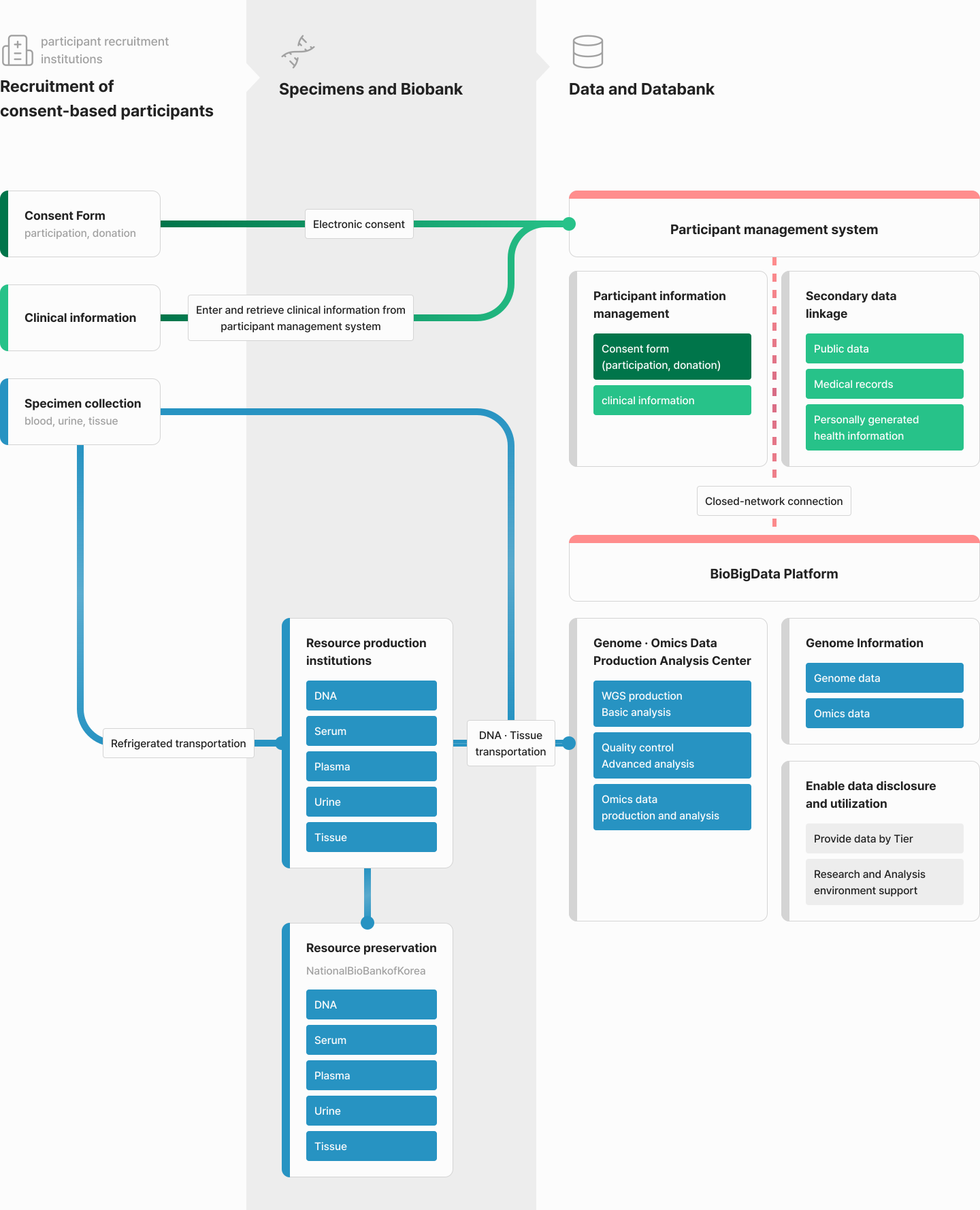
The Databank and Biobank function as human biological material banks and are responsible for the integrated management of BioBigData, including its collection, generation, and provision.
The Databank integrates all collected and generated data and verifies that the data can be provided and utilized for research.
The Biobank manages human biological materials derived from biospecimens, along wit related information, to ensure their appropriate use in research.

Vision & Mission
To establish a national R&D infrastructure by securing 1M participant BioBigData through informed consent, and integrating clinical,
genomic, and public data with personal information for precision medicine and industrial innovation.

Project Flow
Expected Effect

Demonstrate customized medicine
Provides participants with integrated data analysis results to enable simultaneous prevention, diagnosis, and treatment.

Provide R&D infrastructure
Enables research, medical, industrial, and policy applications through the establishment of an integrated bio big data platform
Research applications
- Reliance of overseas data and foreign subject
- Time and cost inefficiencies due to fragment of data collection
- Provision of clinical and genomic data of Koreans
- Reduce research cost through customized databank access
Medical applications
- Reliance on empirical and intuitive medicine
- Realization of data-driven healthcare
Industrial applications
- Limited AI based diagnostics solution utilizing bigdata
- Insufficient bigdata for accelerated new drug development
- Data scarcity for developing healthcare management service and other applications
- Development of medical diagnostic support systems
- Big data-based clinical trial design for new drugs
- Advancement of health management services, etc.
Policy applications
- Insufficient bigdata analysis of policy environment assessment
- Understanding public health crises and identification of response tactics, i.e., COVID-19

Lead bio data standardization
BIKO spearheads biodata standardization using resources of 1M participants.
Adhering to BIKO's guidelines in R&D projects can reduce data collection and utilization costs. Furthermore, integrating biodata across individual projects will expand and accumulate standardized data resources, creating synergies that strengthen the national research infrastructure.